
“One day we shall celebrate again” / RomaMoMA @documentafifteen
“One day we shall celebrate again” / RomaMoMA @documentafifteen
Kassel, July 18 – September 25, 2022
RomaMoMA is a long-term collaborative art project of OFF-Biennale Budapest and the European Roma Institute of Arts and Culture (ERIAC). Through various iterations manifested as exhibitions, events, and publications, and presented at sites across Europe, it has been imagining and prefiguring a transnational museum of Roma contemporary art.
In the framework of documenta fifteen, the group exhibition One Day We Shall Celebrate Again performs a paradoxical double task. On the one hand, in the room behind this wall, it sets out to show what has been invisible and tell what has been unheard in the global scenes of modern and contemporary art—tasks for a transnational museum of Roma art if one had ever been established sometime in the 20th century. On the other hand, it also attempts to deconstruct the very same institutional vision by not only dispersing recent works by five artists of Roma origin throughout the Fridericianum but also, presenting artistic positions that speak to the endless complexity of contemporary identity formations.
This exhibition is the result of a collaboration between Roma curators and artists and non-Roma curators. Inspired by the context of Fridskul, this exhibition’s presentation includes didactic and interactive elements; Daniel Baker’s Shadow Diagram invites visitors to share ideas, while his evocation of the ancient secret language of the patrins playfully reconnects all the artworks of the project. Ethel Brooks’ passionate statements go well beyond introducing the main themes of the exhibition: they are personal contributions in their own right, equal to the presented artworks.
documenta fifteen has been a challenging and fertile ground for this project that allows for adding specific stories of the Romani people to the many narratives brought together in the Fridskul; and that provides a unique opportunity to open up RomaMoMA in the near future for other, comparable experiences and artistic practices that make and unmake the current constructions of the nation state. We must come together, share what we have and work together for a world beyond oppressive borders and labels so that one day, we shall celebrate again…
Artists: Daniel BAKER, János BALÁZS, Robert GABRIS, Sead KAZANXHIU, Damian LE BAS, Małgorzata MIRGA-TAS, Omara (Mara OLÁH), Tamás PÉLI, Selma SELMAN, Ceija STOJKA
Co-curators: Daniel BAKER, Ethel BROOKS, Tímea JUNGHAUS, Miguel Ángel VARGAS
Curators: Hajnalka SOMOGYI, Eszter SZAKÁCS, Katalin SZÉKELY (OFF-Biennale Budapest)
Collaborating institution: ERIAC (European Roma Institute for Arts and Culture)
Consultants: Eszter GYÖRGY, Angéla KÓCZÉ / CEU Romani Studies, Anna Lujza SZÁSZ, Teri SZÜCS
Contributor: East Europe Biennial Alliance
Graphic design: Virág BOGYÓ
Translation: Adele EISENSTEIN, Daniel HOLLÄNDER
Special thanks: Budapest History Museum; Horn Collection, Budapest; Jindřich Chalupecký Society, Prague; Kai Dikhas Foundation, Berlin; KuglerArt Gallery, Budapest; NÖF – National Heritage Protection and Development Non-profit Ltd., Budapest; Rijksakademie van beeldende kunsten, Amsterdam, Fanni ANDRISTYÁK, Veronika BAJAI, Sara GREAVU, Ania JAKA, Tamás KASZÁS, Edit KŐSZEGI, Krisztián KRISTÓF, Robert KUSEK , András MÜLLNER, Moritz PANKOK, Andrea PÓCSIK, Enikő RÓKA, Katarina ŠEVIĆ, János SUGÁR, Krisztina SZIPŐCS, Péter SZUHAY, Wojciech SZYMAŃSKI, Joanna WARSZA, Miklós ZSÁMBOKI
TAMÁS PÉLI: Birth, 1983
(1948, Budapest, Hungary – 1994, Budapest, Hungary)
oil on fiberboard (on 4 panels)
Courtesy of NÖF – National Heritage Protection and Development Non-profit Ltd., Budapest, Hungary
As painter Tamás Péli used to say about himself, “First and foremost, I am Tamás Péli, a lonely figure of Roma origin trying to establish Roma-Hungarian fine art.” In reality, however, Péli was far from lonely: he was surrounded by his friends and disciples—prominent members of the emerging Hungarian Roma civil rights and cultural movement of the 1970s and 1980s. With them the classically trained painter (he attended, among other institutions, the Rijksakademie in the Netherlands), executed his monumental work Birth, whichis of unparalleled significance, in many respects. It arranges the figures of several interwoven grandnarratives into a single composition, following the traditions of 19th-century historical painting, with a monumental figurative style and an almost hagiographic story-telling, creating the illusion of historical authenticity. The center of the piece is an imagined-invented Roma creation myth, that of the Roma ethnogenesis. Symbols from fairy tales—the Sun, the Moon and the Dragon—surround the Goddess Kali, who lifts up the newborn Manus [“Man” in Romani], towards a horse-riding male God. This scene is surrounded, on the one hand, by episodes recounted through symbolic figures of Hungarian Roma history, including the participation of Roma in Hungary’s various freedom struggles throughout the centuries, as well as the tragedy of Porrajmos (‘devouring,’ the term used to describe the Roma Holocaust). On the other hand, the mythological origin story is accompanied by figures of a new genesis—the emerging Hungarian Roma intelligentsia. In this triple-birth a people, a historical narrative, and through its creators, a culture is brought to life. The point of intersection, the manifestation of this triple genesis, is Péli’s gigantic piece.
Painted on fiberboard, the 4-part panel painting was completed in 1983 by Péli with the contribution of his followers. It was installed on the wall of the refectory of the children’s home in the Andrássy Castle in Tiszadob, also known as the “City of Children”. The majority of the children there were of Roma origin, and Péli’s intention was to tell these children an origin story, since their own birth story was mostly unknown to them. Through the collective process of its execution, the painting also turned the children’s home into (one of) the birthplace(s) of the Roma civic movement in Hungary; it is also very characteristic that this pinnacle of contemporary Roma Hungarian culture was installed in a place of care and community. As Péli said, “That small community which owns this painting is mature enough for this role [to look after the painting]. I am talking about the City of Children in Tiszadob. They have the ability to protect and love it. They are aware of its meanings.”
When the castle was turned into a hotel in 2011, the monumental panel was removed and transportedin four pieces to the András Jósa Museum in Nyíregyháza. It was stored in the museum’s corridor, covered—safe, but unseen. However, even in its ‘invisibility,’ its memory lived on in the minds of many: all those who had participated with Péli in the creation of the painting, but also a new generation of Roma artists and activists who, following Péli’s example, wished and still wish to become part of both minority and majority culture.
The painting’s prominent role in Hungarian Roma culture (and beyond) was established by the history of the panel and Péli’s engagement. However, national institutions have hitherto been unable to do anything about the integration of this complex work into the cultural heritage. The presentation of the painting at the Budapest History Museum as part of the OFF-Biennale Budapest in 2021, as well as the current exhibition at Fridericianum in the framework of documenta fifteen, intend to change this situation. They create an opportunity and a space to discuss the issues raised by the painting, such as Roma and non-Roma coexistence, Roma (self)representation, Roma cultural identity, the overtly dominant masculinity present in its imagery, and the question of Roma institutionalism.
Consultants: Eszter György, Anna Lujza Szász, Teri Szűcs
Special thanks to: Budapest History Museum, Dina Darabos, Nikolett Erőss, Tamás Kaszás, Enikő Róka, Krisztina Szipőcs

Tamás Péli, Birth, 1983. Presented at the exhibition Collectively Carried Out organised in collaboration of Budapest History Museum and OFF-Biennale Budapest, 2021. Photo: Ákos Keppel
DANIEL BAKER: Survival Blanket, 2013
(1961, Kent, England, based in London)
crocheted metalized polyethylene survival blanket
Collection Foundation Kai Dikhas, Berlin
The representation of Roma/Gypsy/Traveler communities in Europe is traditionally—for the most part—in the hands of Gadje [non-Roma], who consider Romani art as folk art. As sociologist, activist, writer, and educator Thomas Acton put it, this attitude has changed little over time: “The work of modern Romani intellectuals and artists is often contrasted negatively with something collective, traditional and repetitive called ‘folklore’ or ‘naïve art,’ as though anything produced outside of tradition must necessarily lack authenticity.” Artist, curator, and theorist Daniel Baker is among those Roma artists and intellectuals who have persistently challenged this preconception during recent decades. An ongoing examination of the influence of Romani visual culture, both on Romani communities and on wider society, is at the heart of his work. By employing elements of a Roma aesthetic in his artwork, his intention is for us to look again at objects and narratives that might be overlooked, in order to find meanings that we might not expect. Baker’s works point to the fact that Roma have developed a keen visual sensibility in response to their collective experience of life on the margins of society. The complex vocabulary embedded within everyday Romani artefacts, home décor and textiles is not only a testament to the Roma’s survival strategies and creativity, it also continues to play an important role in the lives of these communities and their interactions with the wider world.
In this vein, Survival Blanket fuses the functional and the ornamental to evoke the often concurrent dualities of comfort and danger, pleasure and risk. As Baker himself puts it: the work “is crocheted from survival blankets, the type used for disaster relief or to conserve the body temperature of accident victims. By utilizing this material—usually intended for use in extreme circumstances—within the seemingly banal realm of hobby craft/domestic pastime, I intended to emphasize the precarious nature of safety and comfort that so many of us take for granted. This work also draws upon the shiny qualities that underpin the Roma aesthetic, to speak of the contingent nature of the Roma experience, where safety and stability are continually at risk.”

Daniel Baker, Survival Blanket, 2013; crocheted metalized polyethylene survival blanket, 183 cm Ø; Collection Foundation Kai Dikhas, Berlin; Photo and © Daniel Baker
JÁNOS BALÁZS: Birds, c. 1972
(1905, Alsókubin, Hungary – 1977, Salgótarján, Hungary)
oil on canvas
Horn Collection, Budapest
János Balázs is one of the few Hungarian artists of Roma origin whose importance has been recognized by the majority society, though the reclusive elderly artist neither needed nor wanted recognition. He was content with his modest circumstances and found real pleasure only in painting and writing. János Balázs, living in a rural Roma slum (in Pécskődomb in the city of Salgótarján) and completing only two grades, read everything he could obtain, from Homer through the Hungarian classics to Shakespeare, Balzac and Nietzsche. He did not form close relationships with others and only started to write poems and paint at the age of 63, as a morose hermit. He lived in a forest— subsisting by collecting mushrooms, fruits, and fallen branches. Local children were the only visitors to his hut and they persuaded him to continue painting after they saw some of his drawings. They brought him the tools: rags, pieces of board and paints.
His paintings and poems were inspired by his reading and the world he depicted was colored by his imagination. History, the common fate of the Roma and Hungarians, myths, and his enormous lexical knowledge all appear in his poems and paintings. In these works, his inner visions are combined with the mystical world of Roma tales and elements of reality. Monumentality, a surreal combination of motifs that completely fill the picture surface, and vivid colors characterize his painting.
Known as the “hermit of Pécskődomb” Balázs also played instruments created by himself. His work was soon recognized within his small community, Salgótarján—and his first exhibition was organized in the local cultural center in 1971. His nationwide fame—unsought and unwelcome—led to a series of international exhibitions, in a period of increased interest in naïve art in the early 1970s. Yet his works go far beyond the stereotypical episteme of “naïve art,” they are a testimony to the unique visionary thinking of a man for whom the wonders of tradition, nature and culture were the only refuge, and whose ‘outsider’ status was as much the result of external circumstances as of his own disposition.

János Balázs, Birds, c. 1972, oil on canvas, 54×62 cm, Horn Collection, Budapest
ROBERT GABRIS: ERROR. ROMA CORPOREALITY AND THEIR NON-BINARY SPACES, 2021
(1986, Hnúšťa Likier, Slovakia; based in Vienna)
installation (textile, print, embroidery)
Courtesy of the artist. The work was commissioned by the Jindřich Chalupecký Society.
Robert Gabris engages with drawings, installation, and performance in his works. His autobiography-led artistic practice intertwines visuality, politics, and social work, attesting to an experimental form of resistance-building against exclusions and oppressions of minority groups. As the artist states, he belongs to the Roma ethnic group but does not define himself as a Roma artist. Many of his works address the complexities and paradoxes of multiple identities: queer—Roma—non-binary.
The starting point of the installation ERROR is a form of community work that Gabris carried out in Košice, Slovakia during his art residency (KAIR) in 2020. The artist met, through an online dating app a number of queer, trans, and non-binary Roma individuals in the East of Slovakia, who are excluded both from the Roma ghettos and from heteronormative Slovakian society. Furthering this engagement, the artist brought the group together, and through a series of meetings and sharing of experiences, traumas, and wishes, they began to formulate future strategies and demands towards majority society.
The double bind of privacy and social openness are mirrored in the ways the intimate photographs and conversations of queer, trans, and non-binary Roma individuals are transferred onto the fabric. The artist disentangled the textile at some parts or put an extra layer of protective fabric to shield the subjects. The textual element of the installation comprises the informal group’s jointly written manifesto in Roma and Slovak language and the excerpts of the discussions embroidered into cloth and ribbons.
The sealing off the space with the ribbon “TAKE A STEP BACK SO THAT WE* CAN TAKE A STEP FORWARD” reflects on what it means to present this work at the venue of the Fridericianum, and what can be done to move beyond having the Roma queer, trans, and non-binary community only as symbolic guests. It is a call for institutions to provide space and to recognize that institutions cannot and do not need to understand everything in that space. As the artist underlines, “‘Take a step back so that we* can take a step forward’ is a precise decision of a community that perceives the superficially inclusive concepts of many dominant institutions as a barrier. This ribbon criticizes a fragmentary institutional discourse that often blindly platforms normativity in the program, thus denying the need for permanent work on oneself and on normative society. How can meaningful alliances be forged and new structures in institutions be made more open and diverse? It is not enough to present at prestigious exhibitions, because the risk is being co-opted and thereby silenced by doing so. The community appeals to society to build a caring institution that does not allow diversity to be exploited. To build an institution on the community’s own terms. Therefore, the space remains closed today, also as a protection for the participants not to reveal their identities.”
Through the course of ERROR, Gabris also met in Slovakia with representatives of health centers, NGOs, and politicians, and is engaged in an ongoing attempt to bring about some kind of infrastructure to tackle the issues the community faces, from poverty, inaccessibility of health care, and sex work to various forms of social insecurities. ERROR was first presented at the Moravian Gallery in Brno, in the Czech Republic, as one of the finalists and collective winner of the Jindřich Chalupecký Award 2021.
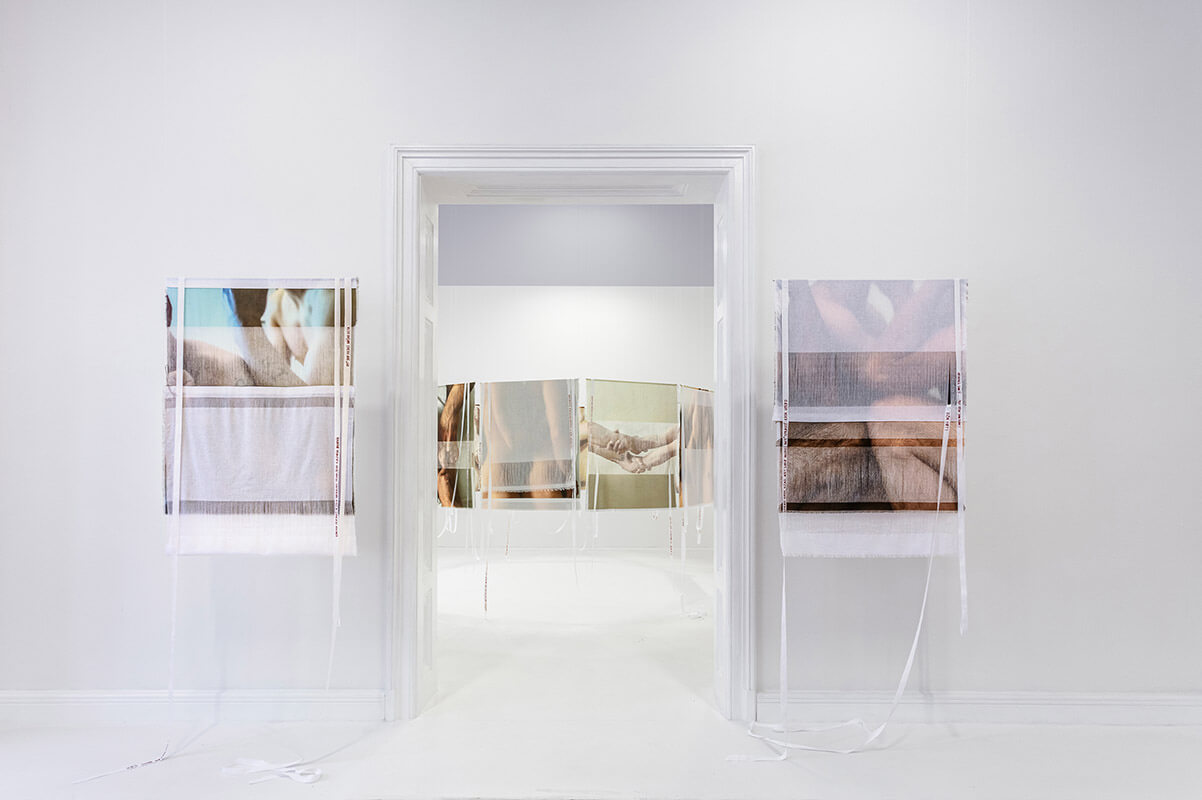
Robert Gabris, ERROR – ROMA CORPOREALITY AND THEIR NON-BINARY SPACES, installation for the Jindřich Chalupecký Award 2021, Moravian Gallery in Brno, Photo by Vlado Elias
SEAD KAZANXHIU: The Nest, 2012–2022
(1987, Baltez-Fier, Albania; based in Tirana)
installation (wood, metallic wire, polyurethane foam, paint)
OFF-Biennale Budapest
In a community well aware of hierarchical structures and underprivileged positions within a nation state, the very condition of being an Albanian Roma citizen was a determining factor for Sead Kazanxhiu. Thus, it comes as no surprise that politics, activism, prejudice, exclusion, and the environment have taken center stage, both in his artistic and activist work. In this sense, his work constitutes the positive effort of a single artist to restore the dignity of a community—the largest ethnic minority in Europe—forcefully and unjustly cornered at the outskirts of European democracy.
First installed on the façade of the Albanian National Museum in Tirana in 2012, The Nest called for the institutionalization of Roma history, art, and culture. The installation, which evokes giant swallow’s nests, articulates the position of Roma art and culture within the context of majority culture in the duality of homeliness and strangeness, in which the communal, grassroots, and caring character of the Roma relationship to institutionalism is as much a feature as a status of constant exclusion. The simple habitat of the little migratory bird is seen by many as a problematic addition to their homes, with little regard for the bird’s ecological value. Similarly, Roma art and culture, with all its merits and achievements, is often considered “outsider.” Yet, swallows are, according to the artist, literally “free as a bird,” and they also have a nest to return to, again emphasizing the paradoxical status of Rromani phuv (Romani Land), the country of this nation without a nation state. The Nest on the façade of Fridericianum not only claims a place for Roma art in the international art world, but also demonstrates and preserves the free and caring nature of Roma culture.
As Kazanxhiu himself puts it, these giant nests, placed in public spaces and institutions, “are used as metaphors to talk about issues, concepts, and cultures that are not part of our public institutions and history, even though we are aware in our consciousness of their existence. In this context, nests are used to create a new reality, in which they take on another function. In this new function, the nests serve as a means to create a physical space for those cultures that aren’t institutionalized and are not part of public institutions. At the same time, they highlight the need for interaction between people and with the environment that surrounds us.”
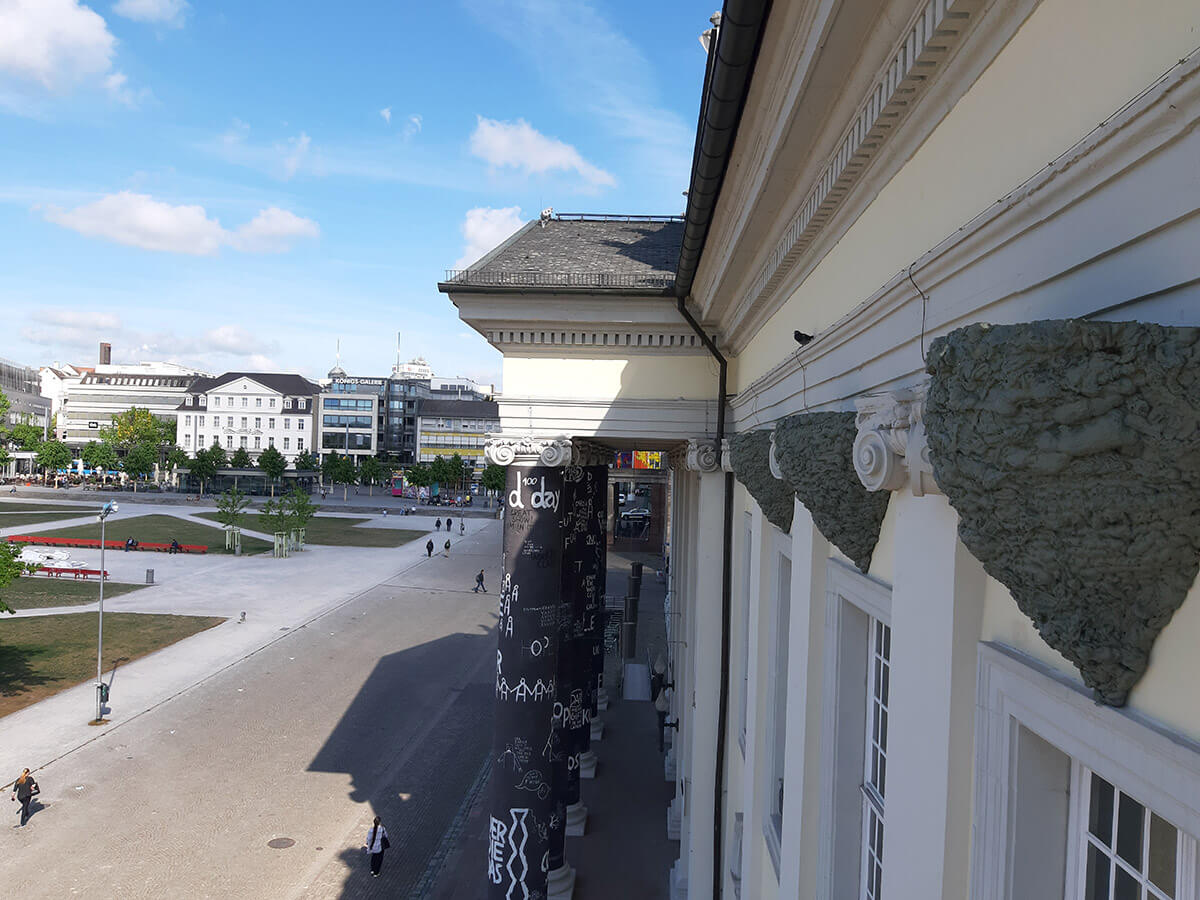
Sead Kazanxhiu, The Nest, 2012–2022; installation (wood, metallic wire, polyurethane foam, paint); Fridericianum, Kassel, Photo: Sead Kazanxhiu
DAMIAN LE BAS: Back To The Future! Safe European Home 1938, 2013
(1963, Sheffield, UK – 2017, Worthing, UK)
mixed media on map
Collection Foundation Kai Dikhas, Berlin
“I’m literally putting Gypsies on the map,” Damian Le Bas would say of his cartographic representations of Europe as seen from a Roma perspective. He associated himself with ‘Outsider Art’ (or ‘Art Brut’)—a conscious choice of an artist who attended the Royal College of Art. As sociologist, activist, writer, and educator Thomas Acton put it, “He is the outsider who, curiously, seems to be at ease almost anywhere. He stands at the confluence of three diasporic currents, his own family’s Huguenot and Irish Traveller heritage and the English Romani heritage of his wife and in-laws.”
Together with his wife, the artist and activist Delaine Le Bas, he was a leading exponent of the ‘Roma Revolution’ in art from the 1990s. They created Safe European Home?, a series of installations that have been seen across Europe since 2011. The title itself is taken from a Clash song, a band well known for taking an active anti-fascist stance. ‘Gypsy Revolution’ and ‘Gypsy DaDa’ were two other artistic ‘movements’ initiated by Damian Le Bas, where a subversive and often transgressive tone was used to question and undermine Roma stereotypes and improve the situation of Romani / Gypsy / Traveler communities and culture. As he said: “From being perceived as Tramps and Thieves with togetherness we can become the Kings & Queens of Gypsyland Europa. After all, wouldn’t Europe be a more boring place without us Gypsies?”
In his last years the artist worked extensively with cartographies and maps, focusing on issues of displacement, borders and boundaries, real or imagined. He questioned the idea of a nation state and the issues confronting Europe concerning migration and the continuing refugee crisis. By positioning Roma people within this historical context, the work makes reference to the current situation regarding migration, particularly concerning social status and its effect on the ability of people to move and work within Europe. It also offers the potential of new ways of living within the confines of a contested space. In Safe European Home 1938, Le Bas redrew a map of Europe to include his trademark Gypsy portrait-heads across every inch of the continent, their features marked by coastlines and rivers and borders, all interlocking, a repetition of eyes, eyelashes, noses, and lips from the Baltic to the Balkans. At first it seems like witty pattern-making, until the viewer notices the somewhat more sinister text, “Gypsys Everywhere,” floating in the Mediterranean.

Damian Le Bas, Back To The Future! Safe European Home 1938, 2013; mixed media on map, 86×99 cm; Collection Foundation Kai Dikhas
MALGORZATA MIRGA-TAS: Out of Egypt series, 1–5., 2021
(1978, Zakopane, Poland; based in Czarna Góra, Poland)
tapestry, mixed media (fabric, acrylic)
Nr. 1-4. Courtesy of the artist, Nr. 5. courtesy of the artist, Robert Kusek and Wojciech Szymański
Presented in collaboration with Re-enchanting the World, Polish Pavilion at the 59th Venice Biennale, 2022. (Curated by Joanna Warsza and Wojciech Szymański)
Polish-Romani multidisciplinary artist, educator, and activist Małgorzata Mirga-Tas’ artistic work addresses anti-Romani stereotypes and engages in building an affirmative iconography of Roma communities. She mainly depicts women in their everyday life: their relationships and alliances, and shared activities. Her vibrant, ornamental textile collages are created from the wardrobes of the people depicted, becoming literal carriers of micro- and macro-histories, and ones that are closely tied to the body.
In her series of monumental textile collages Out of Egypt (produced for her solo show at the Arsenal Gallery in Białystok, Poland in 2021) Mirga-Tas takes the etchings by seventeenth-century printmaker Jacques Callot known as La vie des Egyptiens [Life of the Egyptians]—and, therefore, the entire European iconographic tradition of presenting the Roma—as her vantage point. In a gesture of artistic appropriation, Małgorzata Mirga-Tas processes and decolonizes traditional, historical representations of the Romani people, all of which without exception were created by non-Roma artists. The artist also turns the gender roles in traditional depictions of Roma upside down: in her work, women are the protagonists, and not only those subjected to the colonial gaze.
From the 15th century on, Roma as a collective entity, were ethnographized, and duly construed as the Other of Europe. Combined with poverty, ‘oriental’ details in their attire were displayed as testimony to their non-European origin, and depictions often included ‘well-deserved’ punishment of wandering travelers, and bitterness at having been banished from their homeland, likened with Egypt at the time. Deprived of Roma self-portraits or narratives of how the Romani people perceived themselves, Mirga-Tas explores a retroactive and phantasmatic attempt at (re)creating and restituting the image. In an ironic reference to non-Roma visual testimonies of the past, she further undermines stereotypes built over the years—metaphorically leaving Egypt.

Małgorzata Mirga-Tas, Out of Egypt, 2021. Private collection. Photo by Maciej Zaniewski. Presented in collaboration with ‘Re-enchanting the World’, Polish Pavilion at the 59. Venice Biennale, 2022
MARA OLÁH / OMARA: “Because to this day I can’t swim…” [“Mert én a mai napig nem tudok úszni…”], 2008–2017
(1945, Monor, Hungary – 2020, Szarvasgede, Hungary)
mixed media on fiberboard
Courtesy of Everybody Needs Art and Longtermhandstand, Budapest
As Hungarian-Romani painter Mara Oláh (alias Omara), wrote: “If I did not experience on my own skin the minutes, days, years that only a Gypsy could experience, I would be a dreary painter. If I didn’t experience a lot of humiliation, shaming, disdain, hatred, there would not be this otherness in my paintings that makes me unique. With all my pictures, I want to express emotions, tell stories, fight for freedom against injustice.”
Omara worked as a cleaning lady when she started painting at the age of forty-three when overcoming an illness and losing her mother. Her paintings depict her own life story and are imprints of her cumulative minority status, of the hardships she experienced as a poor, Roma woman, and as a single mother. In her narrative paintings, she expressed the offences she faced, the discrimination she suffered from, while speaking about the fate of the Roma minority. The linking of the figurative and the narrative, coupled with the raw, rough candor of her works, resulted in a unique contemporary language that Omara used to unravel the social reality of her background, beyond coping with her own destiny.
From the beginning she built her artistic career with talent and instinctive professionalism, and an awareness of the mechanisms operating within the art world, which she navigated with ease. Yet, she was also keen to preserve her own voice and create her own space: In 1993, she created Mara Gallery, the first private Roma gallery in Hungary in her apartment in Budapest, which she later moved to her “shabby hut with a pool” in the small village of Szarvasgede.
Omara believed in honesty, and her works and other manifestations were characterized by unvarnished straightforwardness. This is reflected in the language of her captions and other texts, as well as her public appearances, in which she used her position to unravel the mechanisms of the power hierarchy and to make audible, visible and perceptible messages of her identity. Omara applied feminist strategies: when it came to defending the interests of the Roma minority, she did not rely exclusively on visual art. She used provocative actions, demonstrations, and political statements; using printed, electronic, and broadcast media to disseminate her opinion (as can be seen in her performance in the film by artist János Sugár displayed in this space). Omara’s artistic career demonstrates the operation of structural oppression towards the Roma, and offers models on how to revolt against this oppression and on how to reject the majority’s dominance in order to construct new Roma women’s identities.
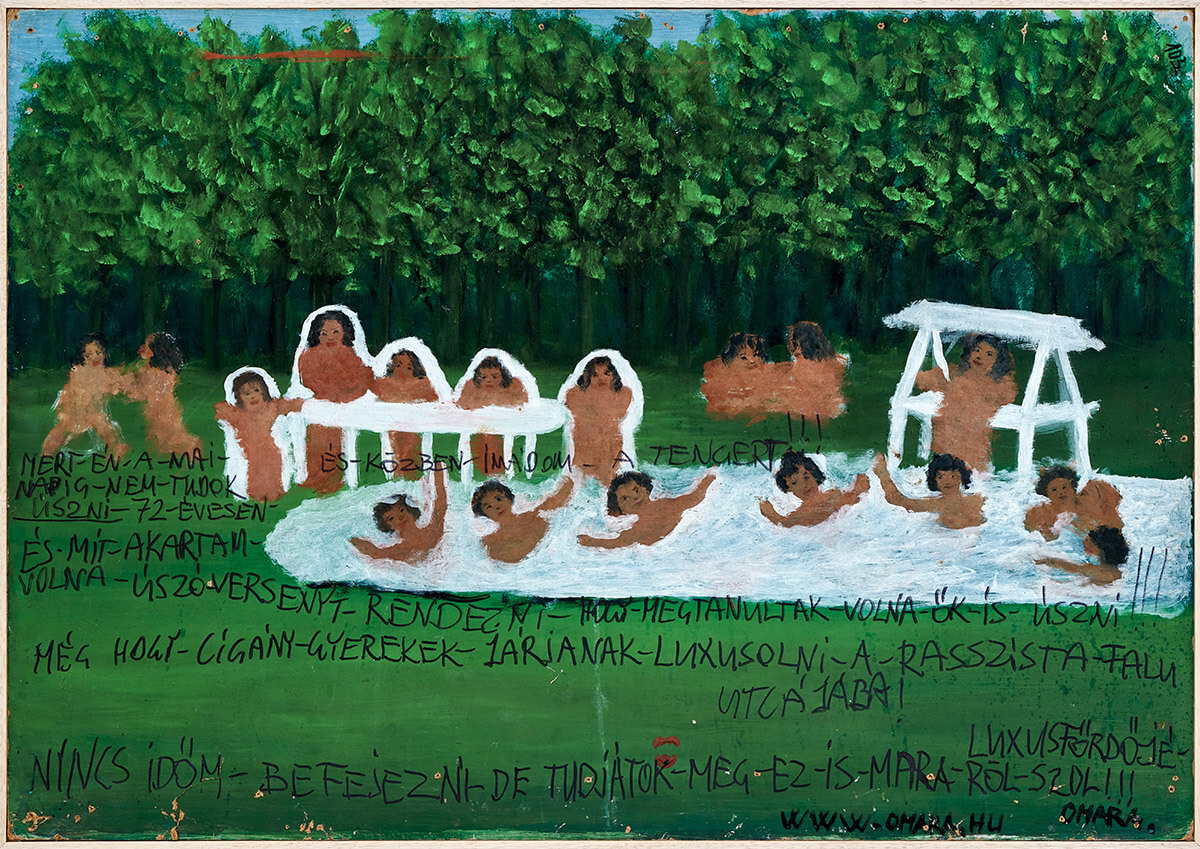
Mara Oláh (Omara), Because I can’t swim – at the age of 72 – and I love the sea !!! And what I wanted – to organize a swimming race – that they would have learned to swim !!!” Even the Gypsy children have this luxury – into the street of the racist village! – I have no time to finish – but you should know this is about Mara’s luxury bath!!!, 2008-2017. Mixed media on wood panel, 70×100 cm, Courtesy of Everybody Needs Art and Longtermhandstand, Budapest
SELMA SELMAN:
(1991, Ružica, Bosnia and Herzegovina; based in Amsterdam)
Paintings on Metal, 2022
acrylic painting on three car bonnets
Courtesy of the artist. Produced with the support of the Rijksakademie van beeldende kunsten, Amsterdam.
Platinum, 2021
video documentation of performance (11’38”), Photo by Almin Zrno
Courtesy of the artist
Platinum (Platina), 2021
platinum sculpture, 33 grams of white gold
Courtesy of the artist
Artist, activist, educator Selma Selman in her art practice intertwines her personal and family history with a wide range of media: painting, performance, photography, installation, writing, and drawing. The body of works presented here engage with the materiality of scrap metal collecting and recycling as well as with issues of labor, valorization, economy, racism, sustainability, the power of art, and strategies of survival.
In the Roma community village of Ružica in Bosnia and Herzegovina, the artist’s father has supported the family through the conversion of metal waste. As Selman states “In my works I carve out separate pieces from vehicles that reside between the painterly and the sculptural. Having had a very personal relationship with metal since childhood, the scrap metal works fuse impressions of everyday life, art history, colloquial language and my own personal experiences.” As an amalgam of roughness and softness, the three painted car hoods depict a self-portrait of the artist, a genre painting of the artist’s family, and a letter to Omer, a fictional character Selman has been engaging with in various works of hers.
The multipart and multimedia work Platinum comprises a sculptural object as well as the video documentation of an installation with six car underbodies and a multi-week performance the artist carried out with her family and friends in 2021 at the National Gallery of Bosnia and Herzegovina in Sarajevo during Selman’s solo exhibition (curated by Amila Ramović). Platinum is based on the fact that discarded scrap metal contains a value that society recognizes as exceptional—precious metals, especially platinum, located in car’s catalytic converters. In the multi-week performance in Sarajevo, Selman’s team found the wreckages of cars, prepared them for installation, and delivered them to the gallery. Together with them, the artist mechanically removed the converters and their contents in which dirt and platinum are mixed. In cooperation with a chemical engineer, a complex process of platinum extraction from this content was carried out. In the end, Selman, in cooperation with a goldsmith, shaped the extracted platinum into a paradoxically doubly “precious” object—a platinum axe. The object is indeed precious for her because it is a tool that is the basis of the work and survival of her family, as well as her own work. But, finally, it is also precious in the way the average spectator sees it—a treasured object like a sculpture or jewelry—even when it is clear that its content is nothing but the collected car waste and the work invested to turn it into value.

Selma Selman, Platinum, 2021. Photo by Almin Zrno
CEIJA STOJKA: “The fear was great behind the barbed wire fence in K.Z. Auschwitz” [“Die Angst war groß hinter dem Stacheldrahtzaun im K.Z. Auschwitz”], 2009
(1933, Kraubath an der Mur, Austria, – 2013, Vienna, Austria)
gouache on paper
Collection Foundation Kai Dikhas, Berlin
Austrian-Romani artist Ceija Stojka was born into a family of itinerant traders who, after the annexation of Austria, were persecuted by the racial National Socialism laws and separated and interned in different concentration camps. Almost her entire family of about two hundred people perished, and only she, her mother and four of her siblings survived.
It was only in the 1980s that Stojka, at the age of fifty-five, and as one of the first Roma woman ever to do so, finally broke the silence about her memories and experiences of the concentration camps. She wrote one of the first Roma autobiographical accounts of the Porrajmos (‘devouring,’ the term used to describe the Roma Holocaust). In traditional Romani society, her book We Live in Seclusion: The Memories of a Romni (Wir leben im Verborgenen: Erinnerungen einer Rom-Zigeunerin, 1988) was seen as a breach of a taboo, since drawing attention to oneself was considered a man’s job. Yet, for her, artistic work on the past became a political intervention in the present. Her “dark pictures” presented here, depicting the fate of Roma during WW2, as well as her “bright cycle”—colorful paintings celebrating the traditions of Roma—are not only warnings about the still-existing anti-Roma tendencies and racism, but also empowering the Sinti and Roma to fight for recognition within an often hostile environment. They celebrate survival, while challenging ongoing contemporary discrimination of Roma people today. As she said, “I want to show my own world to the people. It is important to understand that we are all human beings and art allows us to live and exist. Art can connect us.”
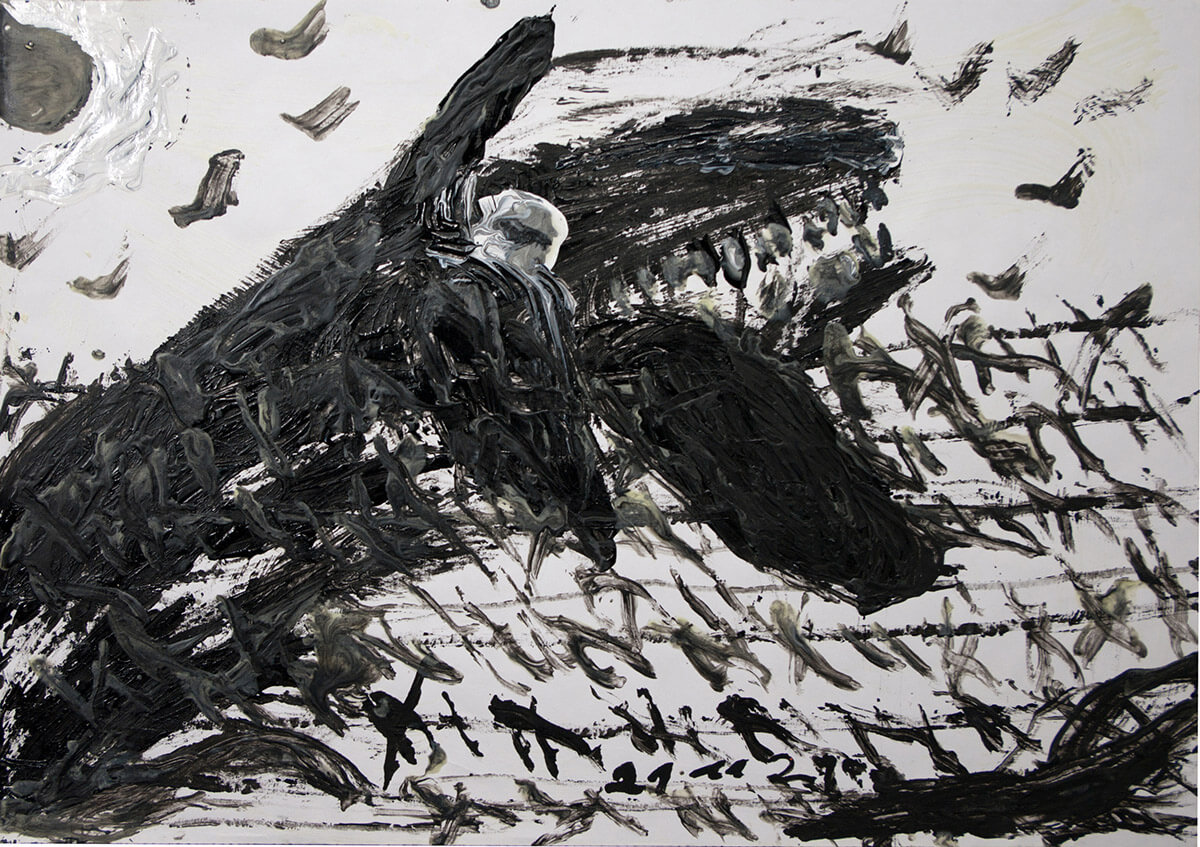
Ceija Stojka, The fear was great behind the barbed wire fence in K.Z. Auschwitz, 2009; gouache on paper, 42 x 29,5 cm; Collection Foundation Kai Dikhas
